
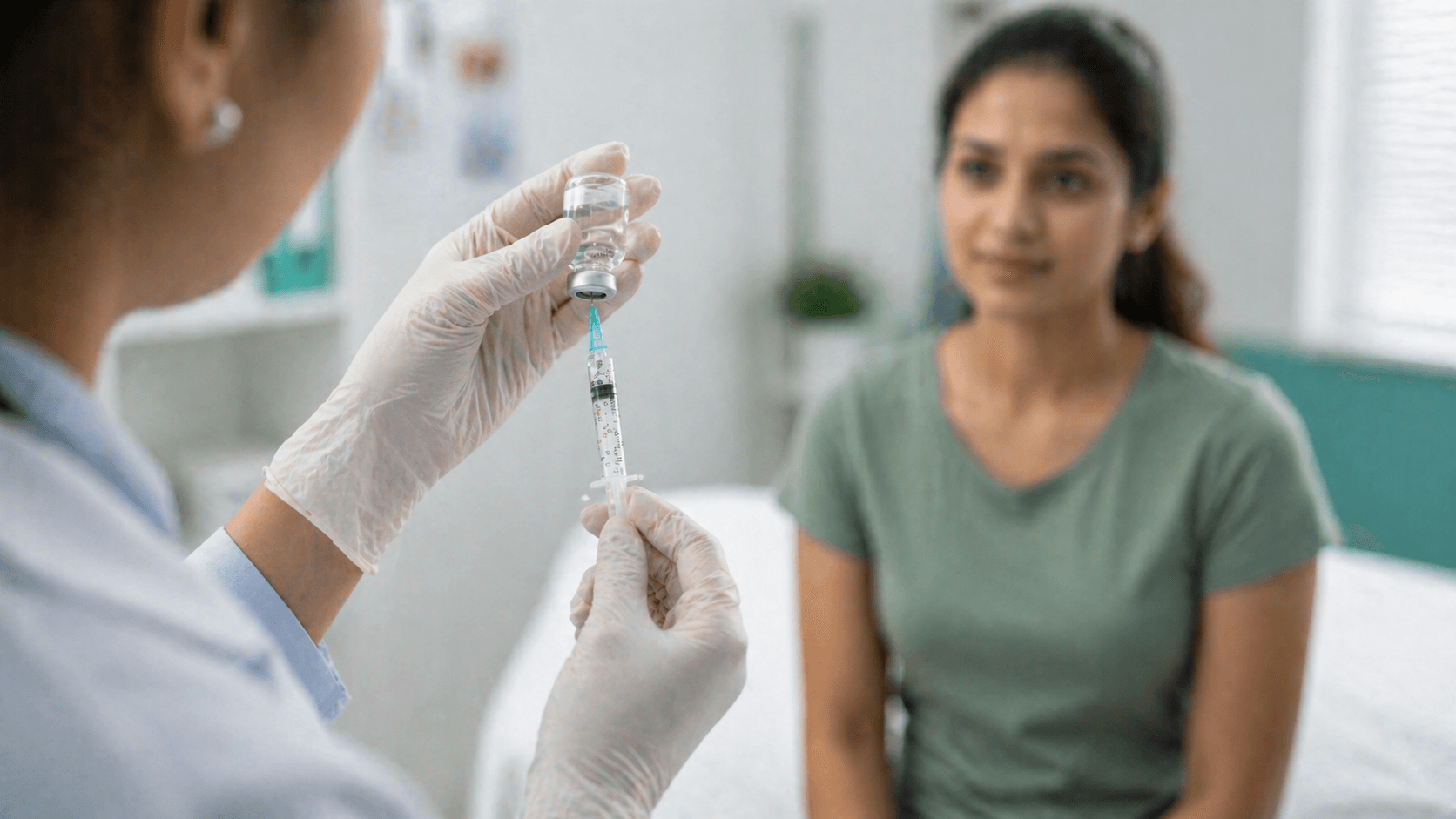
Cervical cancer kills more women in low- and middle-income countries than almost any other cancer. In India, it is the second most common cancer in women. In Nigeria and Ghana, it consistently ranks among the leading causes of cancer-related death. Yet it is one of the few cancers that can be prevented before it starts — not through lifestyle changes alone, but through a vaccine.
This article explains how the HPV vaccine works, who needs it, what the different vaccines available in India actually protect against, and why vaccination does not mean you can stop screening.
What Is HPV and What Does It Have to Do with Cervical Cancer?
Human Papillomavirus (HPV) is a group of more than 100 related viruses spread through skin-to-skin intimate contact. Most sexually active adults will encounter HPV at some point in their lives, and the vast majority of infections clear on their own without causing harm.
The problem is with the high-risk strains. About 15 HPV types are classed as high-risk because they can cause changes in cervical cells that, if untreated, progress to cancer over 15 to 20 years. Two strains in particular — HPV types 16 and 18 — are responsible for roughly 70% of cervical cancers globally and around 76.7% of cases in India. Other strains, notably HPV 6 and 11, do not cause cancer but are responsible for most cases of genital warts.
Critically, HPV does not produce symptoms. A woman can carry a high-risk strain for years without knowing it. Condoms reduce, but do not eliminate, transmission. This is why the vaccine — given before exposure — is so important.
About 80% of sexually active women will encounter HPV at some point in their lives. The HPV vaccine works by preventing the high-risk strains from establishing infection in the first place.
How the HPV Vaccine Works
HPV vaccines are prophylactic, meaning they prevent infection rather than treat it. They do not contain live virus and cannot cause HPV. Instead, they contain non-infectious particles that mimic the outer coat of the virus. When injected, these particles trigger the immune system to produce antibodies. If the vaccinated person later encounters real HPV, their immune system recognises the virus and neutralises it before it can establish infection in cervical cells.
Studies have found that immunity remains strong for over a decade after vaccination, with no evidence that it fades significantly over time. No booster dose is currently recommended. If a scheduled dose is delayed, the series does not need to be restarted — it can be completed where it left off.
Which HPV Vaccines Are Available in India?
Three vaccines are available. They differ in how many HPV strains they protect against:
Vaccine | HPV Types Covered | Protects Against |
|---|---|---|
Cervarix (bivalent) | 16, 18 | Cervical cancer (main strains) |
Gardasil 4 (quadrivalent) | 6, 11, 16, 18 | Cervical cancer + genital warts |
Gardasil 9 (9-valent) | 6, 11, 16, 18, 31, 33, 45, 52, 58 | Cervical cancer + more HPV-related cancers + genital warts |
Both Cervarix and Gardasil are licensed in India and widely available. Gardasil 9 offers the broadest protection. Your gynaecologist can advise which is appropriate based on your age, vaccination history, and budget.
Who Should Get Vaccinated, and When?
The vaccine is most effective when given before a person has any sexual contact — which is why the primary target group is girls aged 9 to 14. At this age, the immune response to the vaccine is stronger, and only two doses are required (given six to twelve months apart) to achieve full protection.
After the age of 15, three doses are required. Catch-up vaccination is recommended and available for women up to the age of 26. For women aged 27 to 45 who have not been vaccinated previously, some benefit is still possible, though the degree of protection is lower because the likelihood of prior HPV exposure increases with age. If you fall into this group, speak to your doctor about whether vaccination makes sense for your individual situation.
Can men receive the HPV vaccine? Yes. HPV causes anal cancer, penile cancer, and throat cancers in men as well. Gardasil 9 is licensed for use in males aged 9 to 26 and protects against the strains that cause these cancers and genital warts.
Vaccination before sexual debut provides the closest to full protection the vaccine can offer. If you have a daughter between 9 and 14, this is the optimal window.
What the Vaccine Does and Does Not Protect Against
The vaccine protects against the HPV strains it covers. It does not protect against strains that were not included in its formulation, and it has no effect on HPV infections that existed before vaccination. This is why vaccination does not replace cervical screening.
Regular Pap smear tests detect abnormal cell changes in the cervix before they develop into cancer. These changes can result from HPV strains not covered by the vaccine, or from other factors. Screening guidelines generally recommend:
Pap smear: From age 21, every three years for women with normal results. After three consecutive normal smears, the interval can be extended to five years.
HPV testing: Recommended from age 30, either alongside a Pap smear or as a standalone test.
High-risk groups: Women with a family history of cervical cancer or a compromised immune system may need more frequent screening.
Being vaccinated does not alter your screening schedule. Both work together — the vaccine prevents most HPV infections, and screening catches any cervical changes that develop despite vaccination.
Side Effects: What Is Normal and What Is Not
The HPV vaccine is generally well-tolerated. The most common reactions are local: pain, redness, or mild swelling at the injection site. Some people feel faint shortly after administration, which is why it is standard practice to remain observed for 15 minutes post-injection while lying or sitting down.
Fever, headache, and brief tiredness are less common but reported. Serious allergic reactions are rare. Women who are currently pregnant are advised to wait until after delivery before receiving the vaccine.
Cervical Cancer in India: What Treatment Is Available
For women who have already received a cervical cancer diagnosis — or who have been told they have precancerous changes — the priority shifts from prevention to treatment. India's JCI-accredited hospitals offer the full treatment pathway: surgical options (from loop excision of precancerous tissue through to radical hysterectomy), chemotherapy, radiotherapy, and targeted therapies for specific cancer subtypes.
For international patients from Nigeria, Ghana, the UK, or elsewhere, MediVenza coordinates access to oncology teams at partner hospitals including Apollo, Fortis, Medanta, and BLK-Max. If you or a family member has received a diagnosis and want to understand the treatment options available in India, you can review the MediVenza oncology treatment page as a starting point, or contact the team directly for a case-specific discussion.
If you would like a broader overview of what treatment categories are available through MediVenza, the treatments hub covers the full range.
Cervical cancer does not have to be inevitable. The HPV vaccine is one of the rare cases where medicine can prevent a cancer from developing at all. If you have questions about vaccination, about cervical health, or about accessing oncology care in India for yourself or a family member, the MediVenza team is available seven days a week. You can reach us on WhatsApp at +91 98996 55596, or submit your questions through the MediVenza contact page.